Guidelines · · 4 min read
Receiving-desk paperwork: what to check before stock is used
Every delivery arrives carrying more information than most clinics keep. The lot number, the batch documentation and the name of the importer can all be read in the time it takes to unpack a carton, and all of them get much harder to recover once the units are on the shelf. What follows is a receiving routine, not a compliance exercise.
Stock arrives, someone signs for it, and it goes in the cupboard. That handover is the last moment a delivery is still a discrete, identifiable thing. Once the outer box is broken down and the units join the rest of the shelf, the paperwork that came with them stops being attached to anything in particular.
The check below takes about a minute. Build it into the receiving routine rather than reaching for it when something goes wrong, because when something goes wrong is exactly when the information is hardest to reconstruct.
The lot number
A lot or batch number identifies a specific production run. It is assigned by the manufacturer, printed on the unit, and usually repeated on the outer carton and the delivery documents. Everything else in traceability hangs off it.
Its practical value shows up in one scenario. A manufacturer issues a notice about a particular run. If you recorded lot numbers on receipt, that notice becomes a short list of units to pull. If you also recorded lot numbers at the point of use, it becomes a short list of patients to contact. If you did neither, the same notice means checking every box you hold, with no way at all to account for what you have already used.
So the first thing to confirm is simply that the number is there, legible, and the same on the unit as on the carton and the paperwork. A mismatch is not automatically sinister. But it is a question to ask before the product joins your stock, not after.
The certificate of analysis
A certificate of analysis is a document tied to one specific batch, recording the results of checks the manufacturer ran on it. What it covers differs by manufacturer, by product type and by market, so there is no universal list to tick against. Read the one you are given rather than assuming its contents.
Two things are worth confirming regardless. First, that the batch number on the certificate matches the batch in front of you — a certificate for a different run tells you nothing about this one. Second, that it has an identifiable issuer. A document with no clear origin is not evidence of anything.
Not every product line ships with one as standard. If you want certificates on file for a category you use heavily, ask your supplier whether they can be provided on request and how long that usually takes. It is an ordinary request. A supplier who cannot answer it clearly has told you something.
Importer of record
Most of this stock is manufactured somewhere other than where it is used. The importer of record is the named business that brought a consignment into the country, and it matters for a plain reason: it is the point at which a manufacturing record held abroad becomes a contactable party close to you.
If a question later comes up about how a batch was handled between the factory and your door, the importer is who can answer it, or who can say who can. Without one you can identify, there is a stretch of the chain you have no way to ask about. Boxes that arrived by an unclear route look exactly like boxes that arrived by a clear one.
What to log
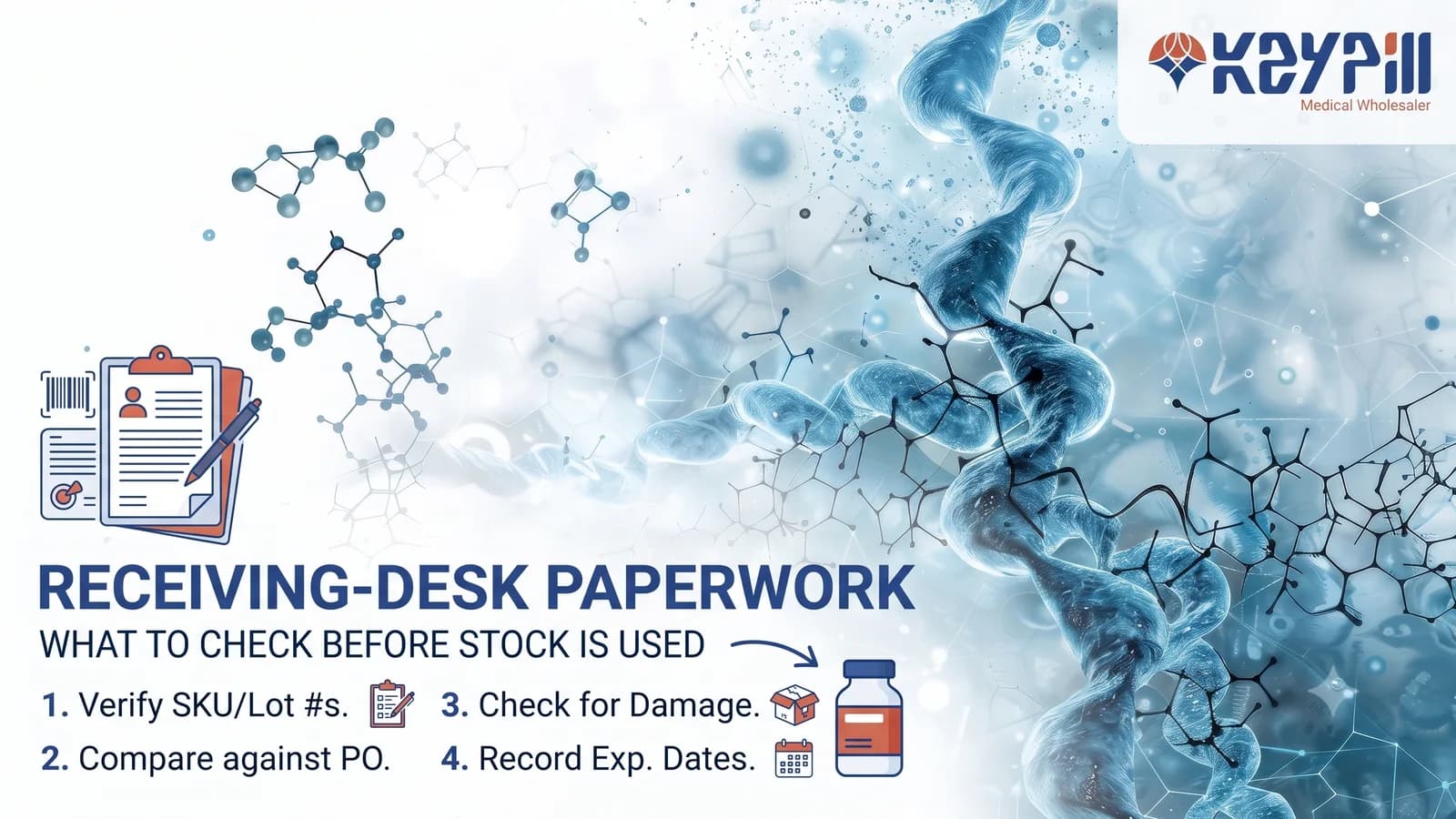
A bound book, a spreadsheet, or the stock module in your practice software — it matters less which than that the record is made at the desk while the box is open, and that it can be searched later by lot number.
- Date received, and who received it
- Supplier, plus the order or invoice reference
- Product name and pack size, as printed on the carton
- Lot or batch number, copied from the unit rather than from the delivery note
- Expiry date
- Quantity received against quantity ordered
- Condition on arrival: outer packaging intact, seals unbroken, and any temperature indicator included in the shipment
- Where the accompanying documents are filed, if not with the log itself
Then close the loop at the other end. Recording the lot number against the treatment, in whatever notes you already keep, is what makes the receiving log worth keeping. A log of what came in tells you what you might still have. A note of what went out tells you where the rest of it went.
What the routine guards against
Plainly: the failure this routine guards against is grey-market stock. Genuine-brand product that reached you by a route the manufacturer did not set up and cannot vouch for. It is less a question of counterfeiting than of an unknown middle — who held the box, for how long, and in what conditions, before the last pair of hands you can actually name.
You cannot see that by looking at a carton. What you can do is make the route legible. Consistent lot numbers, batch documentation available on request, and an identifiable importer are all ordinary things for a supply chain to produce. Their absence is the signal. Not because any one missing document proves anything, but because a clean route tends to generate this paperwork as a by-product, and a route with a gap in it tends not to.
This is not clinical judgement and it does not need a clinician to carry it out. It needs a routine, somewhere to write things down, and a willingness to ask a supplier a direct question before stock is used rather than after. Most deliveries will pass without a second thought. That is rather the point: the minute spent on the ones that pass is what makes the exception visible.
- guidelines
- dermal-fillers
- mesotherapy
Written for trade customers of Keypills Medical Ltd. It covers purchasing, handling and storage — not clinical practice. Always follow the manufacturer’s instructions for use and your own professional and regulatory obligations for any product you administer.